
Contact
Please send your question to:
- Project Coordinator
Ms. Lorena Cabría (TTI), email: This email address is being protected from spambots. You need JavaScript enabled to view it.
- Technical Coordinator
Mr. Mariano López (TTI), email: This email address is being protected from spambots. You need JavaScript enabled to view it.
Dissemination
Dissemination activities of FLEXGAN project will be published here.
Project Events
Publications
-
10 W High Efficiency GaN-Si MMIC Power Amplifier for 17.3–20.2 GHz Onboard Satellite Use (electronic preprint)
Colantonio, M. Lopez, L. Cabria, F. Vitobello, R. Giofrè
-
Power Combining Techniques for Space-Borne GaN SSPA in Ka-Band (electronic preprint)
Giofre, P. Colantonio, F. Di Paolo, (E. E. Dept University of Rome Tor Vergata, Rome – Italy), L. Cabria, M.López (TTI)
- Amplificador MMIC en tecnología 100 nm GaN-Si para la próxima generación de satélites vHTS en banda Ka (electronic preprint)
Rocco Giofrè, Paolo Colantonio and Lorena Cabria
- A GaN-on-Si MMIC Power Amplifier with 10W Output Power and 35% Efficiency for Ka-Band Satellite Downlink (electronic preprint)
Paolo Colantonio and Rocco Giofrè (E. E. Dept University of Rome Tor Vergata, Rome – Italy)
DOI: 10.1109/eumic48047.2021.00019
-
A 17.3-20.2GHz GaN-Si MMIC Balanced HPA for Ka-Band Very High Throughput Satellites (electronic preprint)
R. Giofrè, P. Colantonio, F. Vitobello, M. López and L. Cabria. Paper accepted at IEEE Microwave and Wireless Components Letters.
- A High Efficiency 10 W MMIC PA for K-band Satellite Communications (electronic preprint)
R. Giofrè, P. Colantonio, F. Vitobello, M. López and L. Cabria. Paper accepted at the International Journal of Microwave and Wireless Technologies.
-
125W Solid State Power Amplifier for 17.3-20.2 GHz SatCom Applications (electronic preprint)
Colantonio, R.Giofrè (E. E. Dept University of Rome Tor Vergata, Rome – Italy), L.Cabria, M.López (TTI)
-
On The Burn-in of GaN-on-Si MMIC High Power Amplifiers for SATCOM Applications (electronic preprint)
Giofrè, P. Colantonio, F. Giannini, L. Cabria, M. Lopez, R. Leblanc , F. Vitobello
-
GaN MMIC High Power Amplifiers for K-Band Satellite Payload (electronic preprint)
Colantonio, F. Giannini, R. Giofrè, M. Lopez, L. Cabria
-
Design Realization and Tests of a GaN Solid State Power Amplifier with 51dBm Output Power for 17.3-20.2 GHz SatCom Applications (electronic preprint)
Giofrè, P. Colantonio, L. Cabria, M. Lopez, R. Leblanc , F. VitobelloPaper accepted at First Space Microwave Week – May 2023
-
A GaN-Based Solid State Power Amplifier for Satellite Communications (electronic preprint)
Giofrè, L. Cabria, M. Lopez, R. Leblanc , F. Vitobello, P. Colantonio
Paper accepted at IMS 2023
WorkShops
- From enabling GaN Technology to high-performing Space-borne SSPAs at millimeter-wave
EuMW 2020, Utrecht, The Netherlands, January 2021
Videos
Dissemination material
Other dissemination channels
Consortium
FLEXGAN Consortium is comprised by five partners from three European countries: TTI leading the project and TECNALIA from Spain, AIRBUS and OMMIC from France and UNITOV from Italy. The Consortium includes industrial partners TTI (SME), OMMIC (SME) and AIRBUS, as well as one academia partner from one university, UNITOV, and from one research organization, TECNALIA.
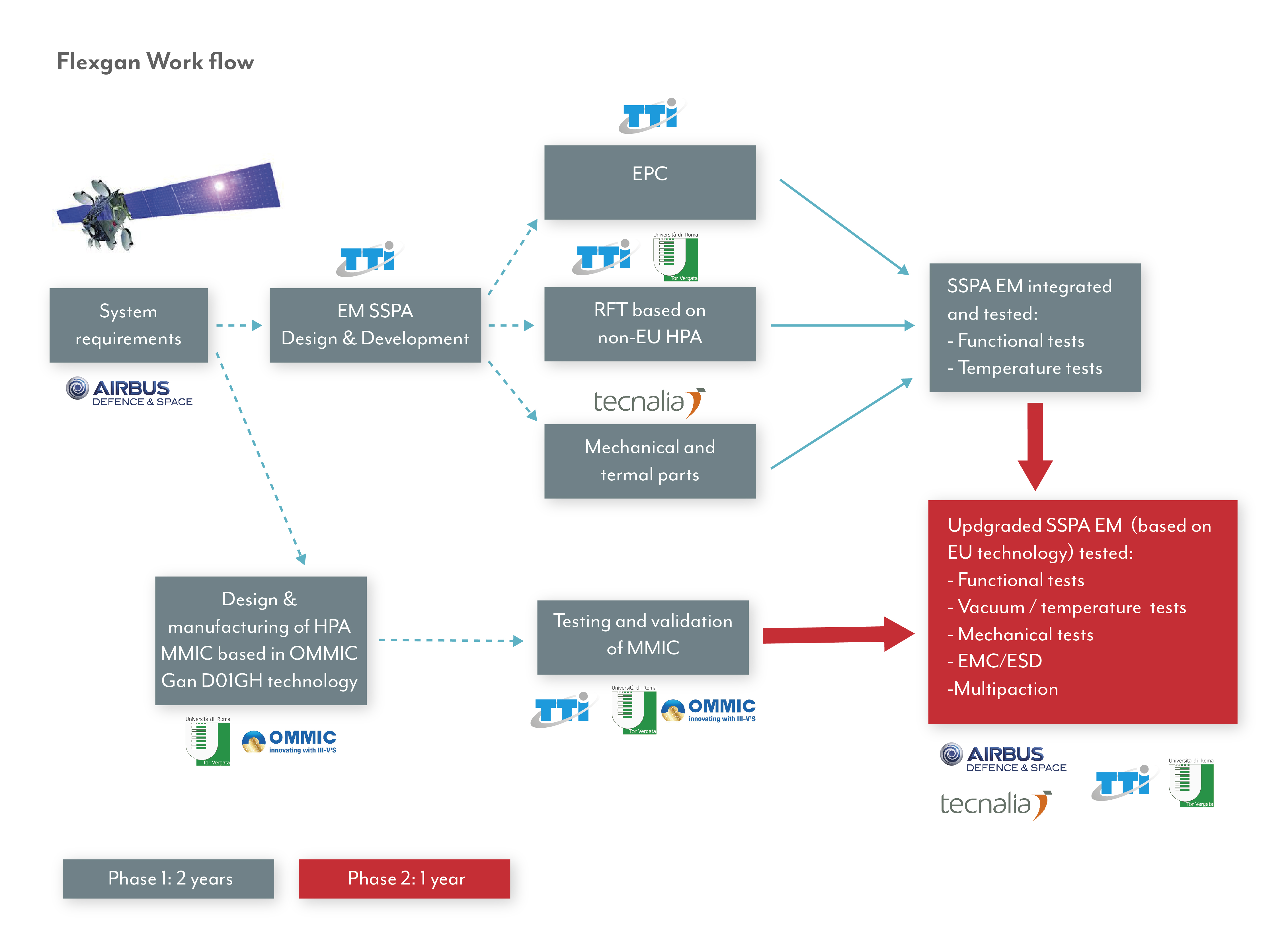
As can be seen in this diagram, the Consortium is well balanced and covers all the supply chain needed to develop the project with success: from the GaN European manufacturer (OMMIC) and requirements identification of final user (AIRBUS), passing through modules design (UNITOV, TTI and TECNALIA), development and SSPA integration (led by TTI), up to TRL5 verification activities (TECNALIA).
 TTI is a SME that was founded in 1996 with 100% private capital, and today remains as an independent and private limited society. Currently TTI comprises an expanding team of 100 highly qualified engineers well supported by key lab and fabrication assets. TTI works in the technological forefronts of space, military, telecommunications, science and information technology sectors. TTI applies its radiofrequency and communication systems experience to develop more efficient equipment to comply with the very demanding requirements for future space qualified high efficiency solid state power amplifiers. TTI has among its customers important national and international technology corporations. TTI has carried out an ambitious R&D program to develop new products and services for its customers, teaming R&D activities with the most prestigious national and European organizations.
TTI develops, manufactures and commercialises high efficiency high power solid state power amplifiers from L-band (350 W CW) to Ka-band (160 W CW) based on GaN and GaAs technology respectively. TTI participates actively with the main European research organisms and with the major telecommunications companies in several R&D projects to develop continuously more efficient and competitive solutions. TTI provides expertise for hardware selection, design, integration and testing of advanced RF and microwave components, equipment and systems.
 Airbus Defence and Space SAS (AIRBUS) is a division of Airbus Group, the company employs 40,000 people and generates revenues of €14 billion per year. Regarding its space activities, Airbus Defence and Space has accumulated more than 50 years’ experience in satellite manufacturing covering all space applications: Earth observation, science, telecommunication and navigation. More particularly, it holds around a quarter of the world- wide communications satellite manufacturing market serving major satellite operators worldwide (more than 100 geostationary satellites to date). AIRBUS has a total satellite communications system capability in-house, from spacecraft and payload design, manufacture, test and launch to the complete ground control and communications infrastructure in-orbit operation and managed services.
To maintain this position AIRBUS constantly monitors the evolution of the ICT usages and the needs of the operators; Airbus Defence and Space thus innovates accordingly and implements a strong research development and innovation effort in its European premises. In particular it has led and participated in many European Research activities in the area of communications, for EC through FP7 and H2020 calls, for European Space Agency and for National Space Agencies.

The Department of Electronic Engineering of University of Roma Tor Vergata (DIE) was established in 1983, gathering the scientific competences in the field of Electronics, Telecommunications and Automation.
Currently it is composed by 14 Full Professors (including 2 Emeritus), 16 Associate Professor, 24 Researchers, 26 technical and administrative people. The expertise of the Department spans over the disciplines of electronics, optoelectronics, electrical, measurement and telecommunications. The research activities are conducted with a multidisciplinary approach, integrating the expertise of different groups.
The Research group participating in FLEXGAN is specialized in the characterization and modelling (either noise, linear and nonlinear) of active devices, and in the development of design methodologies for microwave and millimetre wave circuits (linear and nonlinear, monolithic and hybrid). In particular, it stands out for the development of advanced and useful approaches and methodologies for high efficiency power amplifiers (PAs) design. Broad experience in the realization of both hybrid and monolithic microwave circuits based on GaAs and GaN technologies.

TECNALIA RESEARCH & INNOVATION is a private, independent, non-profit applied Research Centre of international excellence. Legally a Foundation, Tecnalia is the leading private and independent research and technology organisation in Spain and one of the largest in Europe, employing over 1300 people (225 PhDs) and with income of near 100,2 Million € in 2016.
The whole team at TECNALIA has one GOAL: to transform technology into GDP, meaning wealth to improve people’s quality of life by generating business opportunities for industry. TECNALIA is committed to generate major impacts in economic terms, by means of innovation and technological development, addressed by 6 business divisions, covering economic sectors of Energy, Industry, Transportation, Construction, Health and ICT. TECNALIA has been granted over 396 patents and promoted more than 30 spin-off companies.
The Aerospace Business Area of TECNALIA is focused on the development of Lightweight Structures & Components and Functional and High Performance Materials. The Area has more than 20 years of experience applying the above Technologies in industry and is formed of 46 scientists and technicians that deal with calculation, design or redesign of components, material characterization, manufacturing technologies, prototyping and components testing.
 Philips founded OMMIC
on January 1st, 2000, as an independent company with a track record of 30 years of cutting–edge research and development in the fields of III/V epitaxy and integrated circuits technologies. OMMIC has a very clear FAB+ strategy of focusing on high added-value processes, products and services for space, telecommunication, defence and security from 1 GHz to the Terahertz domain.
OMMIC has its headquarters and facility in Limeil-Brévannes on the outskirts of Paris – France. OMMIC has developed the facilities and equipment to allow it to grow its own epitaxial material, perform the front-side processing, to perform backside processing and the characterisation of the technology and circuits. Around these functions OMMIC has also put in place specific software packages to allow the processes to be well controlled (use of SPC) and have complete traceability.
Today the epitaxial activity is based around 3” and 6” wafers, while the foundry is currently using 3” wafers. An investment plan put in place in the year 2000 has allowed OMMIC to purchase since then the majority of the equipment to upgrade to 6” in the foundry.
OMMIC has developed a commercial offering based on adding value to the product. The Space Market now represents around 35 % of the turnover of the company and consists of standard foundry to turn-key delivery of space qualified MMICs and packaged devices. Customer Specific MMICs and standard MMIC products are completing this offer.
Deliverables
Public FLEXGAN deliverables will be uploaded here
|
D1.6 - Project final report summary |
|
D5.3 - Tests results of the EM SSPA |
|
D6.2 - Results of reliability tests on the SSPA |
Objectives
The aim of FLEXGAN is to design, develop and test a TRL5 SSPA based on GaN EU technology (OMMIC) for 5G application in Ka-band satellites (aiming at covering the 17.3-20.2 GHz frequency band and with an output power of 125 W). Concrete objectives for the project have been defined:
- Objective 1: Establish specific requirements for the design and development of a GaN based SSPA suitable to operate in satellite networks operating in Ka-band for future 5G connectivity.
- Objective 2: Design, develop and test an EM SSPA based on non-EU technology. The idea is to have in a first phase a SSPA that could be fully characterised and useful to demonstrate key challenging aspects of the design of an EM SSPA that is fully representative of a FM configuration. In this way as output of objective 2 aspects such as multipaction, corona effects, thermal dissipation, output power flexibility and high efficiency combination at Ka-band will be fully designed and tested in the phase 1 of the project.
- Objective 3: Design and test a MMIC based on European D01GH GaN technology from OMMIC.
- Objective 4: Upgrade the EM SSPA (objective 2) using the MMICs from OMMIC (objective 3) and perform environmental tests in order to have at the end of the activity a TRL5 SSPA. All the research findings and results of FLEXGAN that don’t compromise the future exploitation activities will be disseminated and communicated to the scientific and industrial community as well as to the general audience.

Page 1 of 3